

March 2023
A major influx of ALPINE SWIFTS headlined news throughout the latter half of February, with record-breaking numbers across Britain and Ireland. South-westerly winds extending across the Bay of Biscay from Iberia and North Africa from mid-March produced perfect ‘funnel’ conditions for a large-scale arrival. A harbinger reached Wales over Rhos-on-Sea, Conwy, on 16th, which was quickly followed by two at Lamby Lake, Glamorgan, on 19th, and singles over both Porthcawl, Glamorgan, on 20th, and Aberystwyth, Ceredigion, on 22nd. Last but not least, a couple spent several days roaming the coast between Conwy and Colwyn Bay, Conwy, from 28th, with one at Gronant, Flints, on 29th.
A trio of overshooting Hoopoes were split between Pembrokeshire (two) and Carmarthen; early migrants included all three hirundines as well as several Willow Warblers. The first Pied Flycatcher was at Ynys-Hir RSPB, Ceredigion, on 30th, with a Tree Pipit back in Glamorgan the previous day. A Great Grey Shrike was found near Abergavenny, Gwent.
WHITE-TAILED EAGLE ‘G487’ from the Isle of Wight reintroduction scheme roamed the south-east as far west as Pembrey, Carmarthen, mid-month before heading back east, with a Glossy Ibis at Goldcliff Pools, Gwent on 23rd. Glamorgan birders were treated to a BLACK-CROWNED NIGHT HERON at Lamby on 30-31st.
The BAIKAL TEAL remained at Foryd Bay, Gwynedd, until 22nd and a drake Smew was still on Anglesey. Ring-necked Ducks were at five sites, with six SURF SCOTERS off the north Wales coast. Early returning Garganey, meanwhile, were in five counties.
April 2023
The remarkable discovery of a BLACK-WINGED KITE just outside of Newtown, Powys, on 18th (see more here) headlined action in April, Iolo Williams wasn’t there to see it! This distinctive raptor is fairly widespread globally and has been increasing its range throughout Europe for some time – even breeding around Calais – making this a long-anticipated addition to the British list. However, the location was rather less predictable, in fact the recording area of Montgomeryshire ranks last in both the number of BBRC description species recorded and the total number of species recorded! Unfortunately, the bird was present for all of five minutes before disappearing into the blue skies of mid-Wales. An exclusive finder’s account from Martyn Owen will appear in June’s edition of Birdwatch magazine: https://www.birdguides.com/news/first-british-black-winged-kite-appears-in-mid-wales/.
A significant arrival of BLACK-CROWNED NIGHT HERONS across Britain during April is perhaps the largest ever recorded. At least three made it to Wales – one at Dafen, Carmarthen, and two in Pembrokeshire. Their appearance might not all be good news, however, as severe droughts across Spain and southern France are perhaps partially responsible for their appearance. Owing to their elusive, crepuscular nature, it is all but certain there are more out there to be found …
PURPLE HERONS, meanwhile, were at Llanengan, Gwynedd, Haverfordwest, Pembrokeshire, and Cwmbach, Glamorgan, while a Common Crane overflew Llyn Eiddwen, Ceredigion. Loughor Estuary, Glamorgan, enjoyed a spectacular run of Black-winged Stilts, hosting five different birds during April (two on 23rd followed by three on 28th). The first two continued north, stopping off near Rhyl, Denbighshire, on 25th.
ALPINE SWIFTS continued to arrive en-masse too, with new arrivals over Whitchurch, Glamorgan (two on 2nd), Neath, Glamorgan (one on 6th), and Trefasser, Pembrokeshire (one on 9th). A couple more lingered between Conwy and Llandudno, Conwy, until mid-month, with one of these thought to be the bird logged over Bardsey Island / Gwynedd, on 18th.
A popular RED-RUMPED SWALLOW over Conwy RSPB, Conwy, on 11-12th was just the second county record. Just down the road, a male subalpine warbler species – thought to be an Eastern Subalpine Warbler – was reported in a garden at Penmaenmawr, Conwy, on 20th. An excellent month of Hoopoe reports produced 11 in western regions. Both of April’s Wrynecks were split between the ‘Pembrokeshire pair’ of Skomer and Skokholm, while a surprise Corn Bunting was on Great Orme, Conwy, on 29th.
Notable from a Motacilla persuasion was an Iberian × Ashy-headed Wagtail intergrade at Waungron, Glamorgan, on 16th. Although superficially similar to Iberian Wagtail, the supercilium is restricted to a small white patch behind the eye and the head appears too dark for iberiae. Iberian and Ashy-headed Wagtails regularly interbreed in north-east Spain and southern France, where they are known as ‘Mediterranean Wagtail’.
A PECTORAL SANDPIPER was at Cors Ddyga RSPB, Anglesey, on 29th, and both Dale, Pembrokeshire, and Sker Point, Glamorgan, enjoyed rare Welsh visits by Eurasian STONE CURLEWS. A couple of rare visitors along the Flintshire-Cheshire border comprised a GULL-BILLED TERN and LONG-BILLED DOWITCHER at Burton Mere Wetlands RSPB.
An adult KUMLIEN’S GULL was at Fishguard, Pembrokeshire, on 13th, the same day a SABINE’S GULL flew past Strumble Head. Up to three SURF SCOTERS persisted off Llanddulas, Conwy, with Ring-necked Ducks in Glamorgan, Gwent and Anglesey.
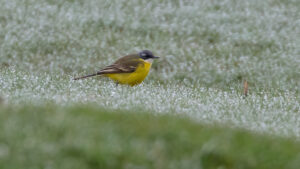 Iberian/Ashy-headed Wagtail
 Corn Bunting
 Gull-billed Tern

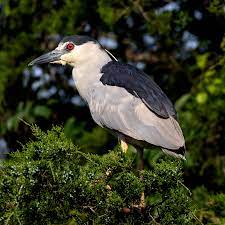 Black-crowned Night Heron


