
The History of the Welsh Ornithological Society
Welsh Ornithological Society
The first nascent shoots of what was eventually destined to become WOS can be detected as far back as 1967; at an informal gathering in Aberystwyth on 15 July representatives of all the regional organisations concerned with birds in Wales agreed that a Welsh Bird Report would be of considerable interest and value. The Editors of the journal Nature in Wales later agreed to provide space for its publication. Thus, Peter Hope Jones (PHJ) and Peter Davis (PD) were in a position to compile a Welsh Bird Report for the first time for the country as a whole, annually for the period 1967 to 1977 inclusive; the former collated records from the northern counties, the latter from the southern ones. This was a great and positive stride forward since before that time reports were purely for individual counties or regions (Cambrian Ornithological Society reports, for example, covered four North Wales counties) rather than the country as a whole.
Unfortunately, the Welsh Bird Report foundered after 1977, not through any lack of interest, but as a result of a change of policy by the then editors of Nature in Wales who were faced with financial difficulties. In the meantime, though, a further mark of progress in Welsh ornithology had been achieved. This was through the setting up, in 1972, of the Welsh Records Advisory Committee, at the instigation of PHJ and PD with the support of county report editors. The objective was to improve the standard of bird recording by providing advice on the acceptance of records of those species which, though very scarce in Wales, were not regarded as British rarities by the national Rarities Committee of British Birds.
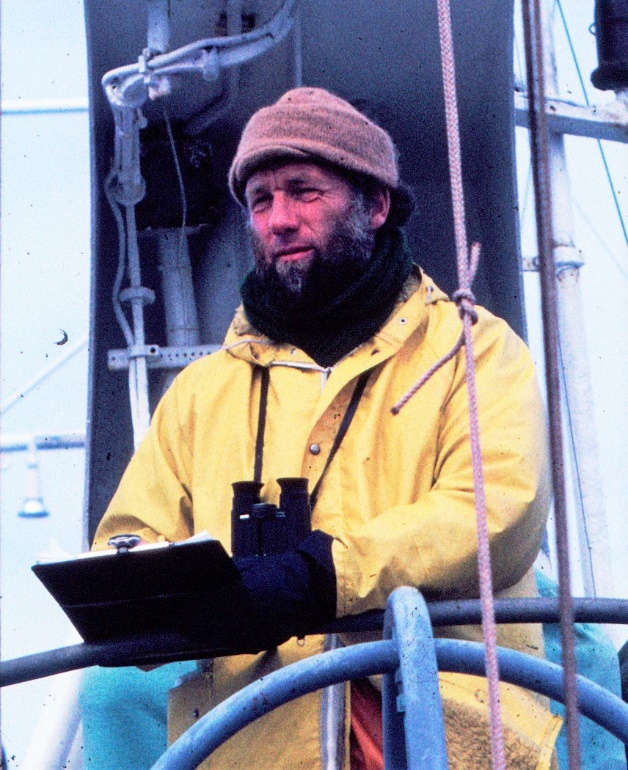
Peter Hope Jones on Prince Madog, surveying for seabirds and cetaceans.
1987 was to prove the crucial year for the concept and establishment of WOS. In that year the Welsh Records Advisory Group, as it had then become, arranged a meeting at the Bear Hotel in Newtown with county bird recorders to discuss the future of bird recording in Wales. This was at a time when there had not been a Welsh Bird Report for ten years, a curb to the progress that had already been achieved, and which focussed the discussions that ensued. It was an historic moment when PHJ as chairman of the meeting proposed that there was an urgent need for a Welsh Ornithological Society, a view which was endorsed by those in attendance.
Encouraged by the support from the Newtown meeting PHJ duly proceeded to arrange a Conference at the College of Librarianship near Aberystwyth on 26 March 1988. At the Conference, which was well attended, the Welsh Ornithological Society was formally floated with the election of honorary officers (PHJ who was the driving force behind the venture was appropriately elected as the first Chairman). Two immediate outcomes were the publication of a Welsh Bird Report for 1978 to 1987 (a herculean task by Clive Hurford) and the establishment on behalf of the new society of an archive at the National Museum of Wales.

Tony Prater at Newport Wetlands in 2011
The first Annual General Meeting took place at the conference in March 1989. The Chair of WOS has changed eight times since formation:
| The Chair of WOS | Date |
|---|---|
| Peter Hope Jones | 1988 - 90 |
| Graham Rees | 1991 - 94 |
| Graham Williams | 1995 - 96 |
| Harold Grenfell | 1997 - 99 |
| Tony Prater | 2000 - 06 |
| Derek Moore | 2007 - 13 |
| Julian Hughes (Acting) | 2014 |
| Mick Green | 2015 - 20 |
| Anne Brenchley | 2020 - Present |
The Council was originally made up of the Recorders from across Wales. In 1995 Council first discussed the possibility of arranging fieldwork for an all-Wales tetrad Atlas. However, this was at a time when nobody on Council was a computer user and the project got no further. In 1995 also, there was mention of an invitation from the BTO to have joint conferences, as part of a drive by the BTO to reach more fieldworkers. It appears that from 1996 on the annual conference was a joint WOS/BTO conference and continues as such to this day.
In 2007, Derek Moore was elected as Chair and soon after there was discussion to establish a new, and simpler constitution. Derek argued that Recorders like to meet to talk about birds, not to do the necessary tasks to run an organisation. The new constitution did not, therefore, have Recorders as members of Council. People were to be nominated, some of whom included Recorders, and the work of Council became to ensure that WOS ran effectively as an organisation in order to support work of recording birds and assisting their conservation. Derek brought his experience of successfully running the Suffolk Wildlife Trust and helping sort out the finances of the West Wales Wildlife Trust, to bear on WOS and throughout his tenure as Chair continued to champion young birders and the contributions they could make to ornithology across Wales – hence the establishment of the Derek Moore Student Research Award and the promotion of Young Conservationists Bursaries.
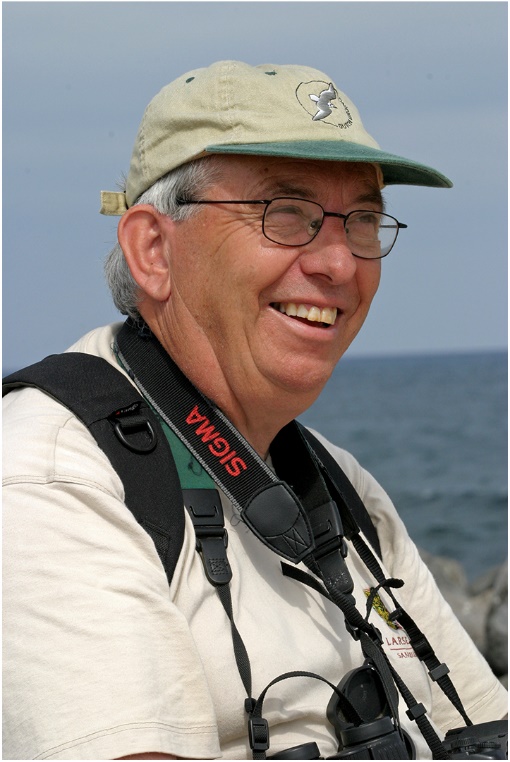
Derek Moore was instrumental in promoting support for young birders and researchers.

The Birds of Wales 2021, published by Liverpool University Press.
There had been concern about the declining number of members who attended the conference in March each year. It always had competition, not least from the Six Nations rugby tournament. From 2007, Council decided to move the date of the conference to early November, when, it was thought, there were fewer likely clashes with other events. It was decided to move away from the venue at Aberystwyth and move the conference around Wales, to the south-west, south-east and north in a three year cycle, in the hope that this would make it easier for both members and non-members from different parts of the country to attend. The conferences generally had 100-120 delegates until 2020 when the COVID pandemic stopped face-to-face conferences. The 2021 conference was conducted via Zoom with the help of technical support at the BTO HQ and face-to-face conferences resumed in November 2022. Currently the conference is located at the University of Aberystwyth each year.
Following the publication of the Welsh Bird Report No. 7 1993, WOS established a new journal, ‘Welsh Birds’, which included an edition with papers written about ornithological issues in Wales and another as the Welsh Bird Report. For some reason the numbering of the editions was such that a full volume took three years with six parts. From 2004-10 there was another part, e.g. ‘Rare and Scarce Birds in Wales 2005’. This continued with a printed report until the 2010 edition. The journal then changed its name to ‘Birds in Wales’ starting at volume 7, with a new volume each year. The journal has now been renamed ‘Milvus’ from the 2022 volume onwards.
In 2021 WOS published a new avifauna for Wales, to mark the 30th anniversary of the founding of the Society.
Graham Williams and Ian M Spence.