
Bob Harris and Pete Coffey, who’ve led long-term nestbox studies of Pied Flycatchers in Welsh woodlands, are two of the co-authors of a fascinating (and extremely complex) analysis of factors affecting changes in Pied Flycatcher populations in seven areas of the UK, two of which are his (Merseyside Ringing Group) main Welsh study areas in Denbighshire and Dinas. Although Pied Flycatcher has now moved off the UK Red List to the Amber List, there are continuing concerns about a declining breeding population and suggestions that earlier springs resulting from climate change have resulted in a lack of peak food availability at critical times during the nesting period. This paper (Spatial consistency in drivers of population dynamics of a declining migratory bird) suggests that population changes may be much more linked to mortality outside the breeding season – on migration and in winter quarters – than breeding habits, although our high Welsh rainfall appears to lead to lower survival rates than the other UK populations (Scotland and south-west England) in the study.
The full paper is well worth studying. The complex statistical modelling is pretty mind-blowing, but it’s an excellent example of how big data can be imaginatively used to start solving some of our conservation conundrums.
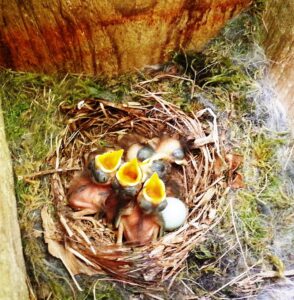
Pied Flycatcher nestlings in a Denbighshire nest box – photo by Giles Pepler