The Welsh Bird List 2026
The latest edition of the list of birds recorded in Wales has been published, but it’s more than a list. It also reminds us how the environment is changing, writes Welsh Bird Report editor Julian Hughes.
The Welsh Bird Report 2024 will arrive with WOS members very soon, the only annual report in the UK that covers a whole nation. As well as documenting the birds in that year, it provides a wider context for the changes that birders notice when out in the countryside. The Report includes the annual update of the Welsh List, which this year saw two additions: Hudsonian Godwit and Black-faced Bunting. Pictures of the 2023 additions are shown in the gallery below, together with a photo of the 2024 Hudsonian Godwit, in a flock of Black-tailed Godwits. Pictures of the 2024 Black-faced Bunting can be seen in the 2024 Scarce and Rare Birds in Wales.
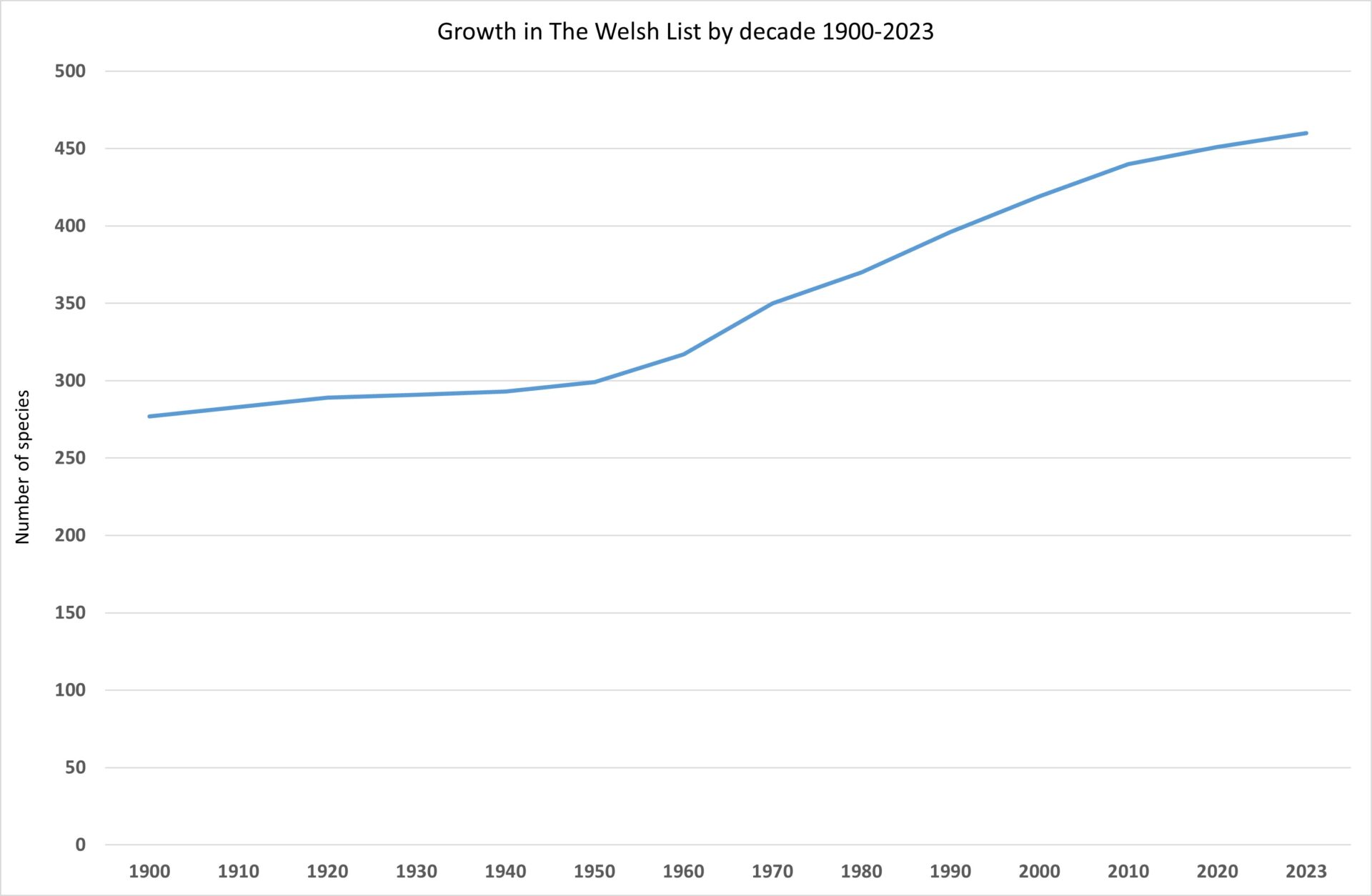
The List follows the latest version of the IOC World Bird List (version 14.2), an international taxonomy that last year ‘lumped’ three species of Redpoll into one and ‘split’ Red Grouse as an endemic species in Britain, as well as altered the order or names of several dozen other species. All this brings the total number of species recorded in Wales to 460 at the end of 2023. This chart shows that the rate of increase has not slowed much since the 1970s, and with seven years of the decade still to go, it looks set to maintain that trend.
The status of several species has been updated to reflect their changing abundance in the last five years. Bewick’s Swan, for example, is now listed as Scarce and is close to qualifying as a species for which a description is required by the Welsh Birds Rarities Committee (WBRC). Little Auk has also been re-categorised as Scarce, and is now sufficiently rare to be monitored by the WBRC. Lesser Scaup, Black-winged Stilt and Caspian Gull are among the species that although still Rare in Wales are no longer classed as Very Rare or Extremely Rare.
The pace of change in status of breeding species tends to be slower than those of migrants, but there have been a few. It’s very welcome that Bittern and Marsh Harrier are no longer classed as Occasional Breeders as they have become established at several sites thanks to reedbed restoration. On the negative side, Grey Partridge is now considered no more than an Occasional Breeder, although its true status is clouded by releases, and birders are encouraged to report all records of wild-hatched coveys.
The Welsh List is updated annually, usually published each January. No doubt next year will bring further changes. The Pembrokeshire Great-tailed Grackle in 2024 is under consideration by the British Ornithologists’ Union Rarities Committee and the upward trend in Cory’s Shearwaters associated with warmer water in the Western Approaches means that it may soon be considered a Regular Passage Migrant rather than a Scarce one. Meanwhile, the collapse in the European breeding population of Aquatic Warbler, and thus a dearth of recent records in Wales, suggests that it will soon be reclassified as Rare.
The Welsh List 2026 can be downloaded from the WOS website, as can a spreadsheet that details the status and categorisation of each species.
Article based on Thorpe, R.I. and Stratford, A. (2024). The Welsh List: a checklist of the birds of Wales (8th edition). Milvus 3(3): 262-264.